Gas Station Blues — or Why a Little Regulation Around Kratom Isn’t a Bad Thing
I
have been making Dopey: On the Dark Comedy of Drug Addiction for almost 11 years. I started the podcast with my late friend Chris O’Connor, whom I met in treatment for our shared IV drug addiction. Our show became a magnet for drug addicts because we celebrated depravity and approached sobriety from a true degenerate point of view. We have always encouraged the audience to send in their stories of drugs, addiction, and dumb shit. Kratom came up every now and then among the listener submissions, but over the past three years, it’s become one of the most common things we hear about.
Read more Lindsay Clancy’s Ex-Husband Testifies at Murder Trial: ‘She Kept Getting Worse and Worse’
Kratom comes from a tropical evergreen tree native to Southeast Asia, which has leaves that contain several psychoactive compounds. Among them is 7-hydroxymitragynine, better known as 7-OH. A few years ago, companies figured out a way to create 7-OH in a lab, and started selling it as a concentrate. The effects of Kratom or 7-OH change depending on how much of it you take: at low doses, it acts as a mild stimulant but at higher doses it produces opioid-like effects. The U.S. Food and Drug Administration (FDA) has not approved any kratom drug products and warns against its use due to risks of addiction, misuse, and dependency. In July, the Drug Enforcement Administration (DEA) announced its intent to make 7-OH products — though not the powder made from the leaf — Schedule I.
Schedule I drugs are substances with a high potential for abuse, no accepted medical use in treatment, and a lack of accepted safety under medical supervision.
Kratom took off in America in the mid-2000s as a “supplement” with an endless collection of claims. It could give you energy for a workout. It could help with anxiety. It could help you sleep better. It could even help opiate addicts stop using opiates. At first, it was just the powder, which contained a swath of different types of alkaloids, including trace amounts of 7-OH. But soon, companies started making 7-OH concentrates, and they were available everywhere.
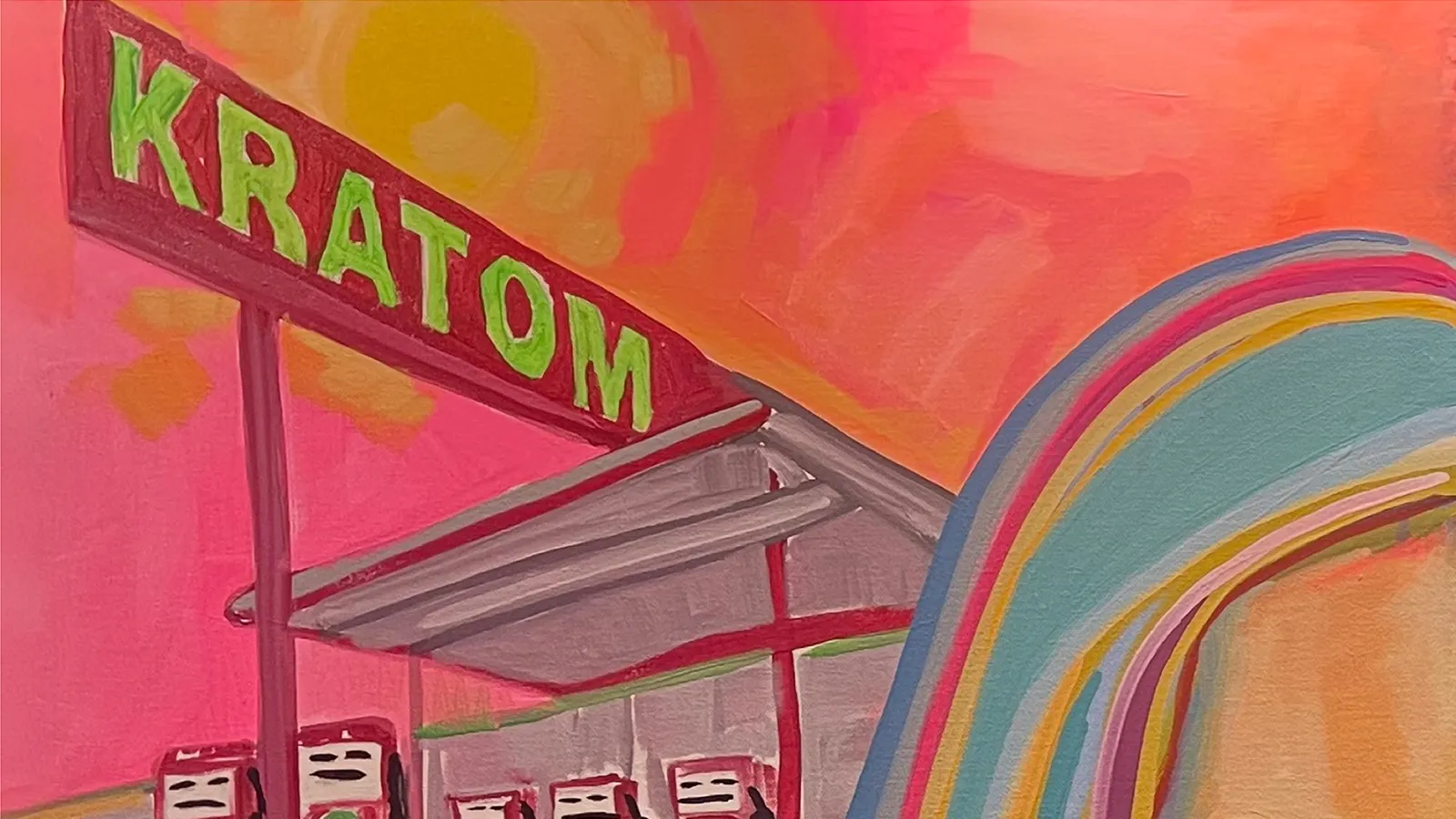
Today, they are sold in colorfully catchy packaging in forms of powder, tablets, liquid shots, gummies, and even vapes. They are available in smoke shops, gas stations, and bodegas. They are relatively cheap, typically around $10, and are inconsistently regulated — if at all.
The weird thing was that I never even noticed Kratom or 7-OH until I heard about it from people listening to my podcast. I just assumed Kratom was bunk. Over the years there have been countless products with less than stellar “getting high” effects, sold in head shops with claims of real results that rarely delivered what their marketing promised. Once in a while a product worked — because it contained stimulants such as ephedra. Oftentimes, shitty drug dealers and rip-off artists would sell these products at schools or concerts claiming they were MDMA, speed, opiates, or weed. It was an old scam, and I figured Kratom was just the latest one.
It turns out, and definitely not for the first time, I was wrong. Kratom worked. It worked so well people were using it not only to get high, but as harm reduction, too. To get off of alcohol and whatever other substances they were taking.
I got an email recently from a listener, ‘K,’ about Kratom, or more specifically 7-OH:
“I’ve struggled with a bunch of different addictions that were ruining my life — alcohol, coke, molly, Xanax, literally anything I could get my hands on. I was on a bender for years. I started with the [kratom] powder but then needed more and more and moved to 7-OH… The good thing about 7-OH is it got me off of everything. I was incredibly destructive and violent, and it chilled me out. All I would do is stay at home, and I liked that version of myself.”
K stopped using it soon after they wrote because they noticed themself dependent. Four days after they stopped, K wrote to me again:
“Honestly, I don’t think I’ve ever felt so depressed and in pain as I have the past few days. Hands down these were the worst withdrawals I’ve ever had and I’ve withdrawn from everything lol.”
Read more MAGA Rep. Allegedly Assaulted Wife, Put Gun to Her Head. Republicans Don’t Care
B. Getz, my friend and host of The Upful Life podcast, used powdered kratom every day for nearly nine years after a long and painful addiction to OxyContin. Kratom changed all of that. “What I realized was, this shit turned that switch off in my brain,” Getz tells me. “I look at kratom as a lifeline for me.” Kratom helped Getz get work, build a life, and ultimately get off of opiates. Kratom became the substitute, essentially working as replacement therapy. It became something he carried everywhere — a water bottle and a fanny pack filled with powder. “I could not go anywhere, do anything, without knowing I had my kratom dose on me,” he says. Getz is off Kratom now because of that dependence but doesn’t regret using it. “Just because I sing its praises does not mean I’m invalidating anybody else’s [negative] experiences,” he says.
Dr. Evan Haines, co-founder of Oro House Recovery Centers, believes the arrival of 7-OH fundamentally changed what treatment providers were seeing. “I have mixed feelings,” Haines tells me. “On the one hand, the consensus is that the war on drugs has been a total failure, so it’s usually never good news when a new drug makes it onto the schedule.” Haines says Oro House has experienced “a huge increase in people seeking treatment” for kratom and 7-OH both. “We had never seen someone seeking treatment for [powdered] kratom before [concentrate]7-OH came along.”
Jana Wu, a clinician at Mountainside Treatment Center who has worked extensively with people struggling with Kratom, has seen first-hand the devastation that kratom and 7-OH can cause.
“I’ve worked with people who were dosing every three to four hours, waking up in the middle of the night to use, and organizing their entire lives around obtaining the next dose,” Wu tells me. “That’s addiction, regardless of how the product is marketed.” But Wu also rejects the idea that Kratom can be neatly classified as good or bad. “The more important conversation is about why people are searching for relief, how an increasingly commercialized and sometimes predatory marketplace has evolved around that demand, and how today’s products are often very different from the traditional plant.”
It is clear that both Kratom in leaf and powdered form and concentrated 7-OH can be addictive — but would banning it actually reduce harm? Maia Szalavitz is an acclaimed author and journalist who has covered addiction and drug policy for decades. She believes policymakers must consider what people will substitute instead. “The goal of drug policy needs to be reducing harm overall,” Szalavitz tells me. “And that means when you’re considering banning something or making it illegal, you have to consider the whole context.” That context includes fentanyl. “When you are trying to take something away in an environment where fentanyl may be the alternative for many people, that might not be such a great policy. We do know that a lot of people who were cut off from pain medications are using Kratom and potentially 7-OH. We know that people who are trying to wean themselves off of fentanyl are using both of these things, as well. Now, if you take 7-OH out of the picture, will they just go to powder Kratom or will they go to fentanyl? We don’t know.”
Szalavitz sees both commercialization and prohibition as failures when it comes to regulation. “The worst form of drug regulation is prohibition and the second worst form is commercialization,” she says. “We just seem to do both of those and never really the proper regulation.”
Author and harm-reduction activist Tracey Helton echoes Szalavitz’s sentiment. “Prohibition generally pushes people into more dangerous solutions,” she says. “Kratom does have benefits to some folks, especially people looking to step down from fentanyl and those who have unmanaged pain. I think a better solution would have been to have it tested, labeled, and regulated.”
After nearly 11 years of making Dopey, I have heard an inordinate amount of opinions on harm reduction. I have heard from people who believe Kratom saved them from fentanyl, people who say 7-OH became their new heroin, and people who believe any and all mood- and mind-altering substances are beyond dangerous. Jamie Lee Curtis, a recurring Dopey guest and friend of the pod who has been super open about her own abstinence-based recovery, is unequivocal. “I have a longtime sober friend who went out hard on Kratom. They ended up seeking treatment,” she says.
My friend and Dopey co-founder, Chris, died from a fentanyl overdose in 2018. I have heard from scores of people who say Kratom or 7-OH helped them to stop taking fentanyl. If Kratom does keep somebody away from fentanyl and improves their chances of staying alive, then I am all for it. If that same person begins using it around the clock, waking up in the middle of the night in withdrawal, and living for their next dose, well, that doesn’t sound too free to me. I was on a methadone program for seven years, and I never felt free. In fact, I felt the opposite — they don’t call it “liquid handcuffs” for nothing.
Ideally there would be enforced age restrictions, accurate labels, independent testing, and honest potency information to protect people, especially the kids who are able to casually buy it due to lax store management. it at the counter of all these stores. Twelve-step, abstinence-based recovery saved my life, but it is not the only way people survive addiction or find recovery. There are infinite ways out of active addiction. There is medical-assisted treatment, harm reduction, dharma recovery, smart recovery, and countless other recovery flavors. With this new legislation, 7-OH is likely to be leaving your local smoke shop. Kratom in other forms? That’s less clear. I think I was fortunate that my substances of choice were never available in my gas station.
Read more Trump Finds Consolation in Posting Dozens of AI Slop Delusions