The White House UFC Fight Was Donald Trump’s All-American Dream
I
t is the night before the Ultimate Fighting Championship at the White House and I am in a sticky-table sports bar somewhere in the vicinity of Washington D.C.’s Chinatown listening to a man tell me all about trading cards.
Read more Jalen Brunson, the Knicks, and the Miracle of Greatness
I don’t know anything about trading cards, but this guy is really into them. Supposedly they hold value, depending on their condition and rarity and whether or not they are signed by the athletes on them, who in this case are all professional fighters. The man is short and square with a big round-trimmed beard and a snap-back hat and a deliberately mismatched pair of Jordans, one red and one blue. He tells me his name at one point and I do not remember it, because I have taken one shot of whiskey every 10 minutes since entering the bar roughly 40 minutes ago, and really the only thing vaguely holding my attention at the moment is these cards, little shiny pictures of fighters in plastic sleeves that have come out of a torn cardboard box that this man is carrying around with him.
Here is his most valuable one, a rare version of the legendary Russian fighter Khabib Nurmagomedov. Here is his favorite, a rare image of the beautiful women’s strawweight champion MacKenzie Dern. This is a true fight fan, someone who lives and breathes the sport of mixed martial arts, who watches old, classic fights with his young son, and who knows dollar values, roughly, of all of the cards in his collection, which he is desperate to add to. At the table with us, fucked-up drunk, are a couple of other journalists and a minor but somewhat influential celebrity in this big wide world of institutionalized violence, all of whom have connections to many of the people on the cards, which is why they are, figuratively and literally, on the table.
This man is laying it all out there. If the celebrity could manage to get one signed for him, it would be huge. “It’s not even about the money, bro. It’s not about the money, I just want to have it,” he says. Despite the whiskey I feel a little too sober to be around that kind of want. It is uncomfortable and raw, but not uncommon when it comes to MMA, a sport that offers immediate catharsis every time a punch lands and a body bounces off the mat. People get into this sport because watching that makes them feel strong in ways they often cannot in everyday life. But when you drag that sentiment out in public after five shots of bourbon in front of a minor celebrity and other guys you barely know, nobody really knows what to do with it. The celebrity took custody of one of the cards and said he’d do what he could, speaking to the man in a far gentler tone than I expected, given the circumstances. After a while, the man goes outside. When I stumble out sometime later, he is still there, sitting on the ground with one of his friends. It is well after midnight at this point, the day ticking over to Sunday, June 14. The man says it’s his birthday.
The man I met that night shares his birthday with someone else: President Donald Trump. Unlike the drunk fan in the shitty bar, this year, Trump got everything he wanted. This is the difference between Donald J. Trump and you: what Trump wants, he gets.
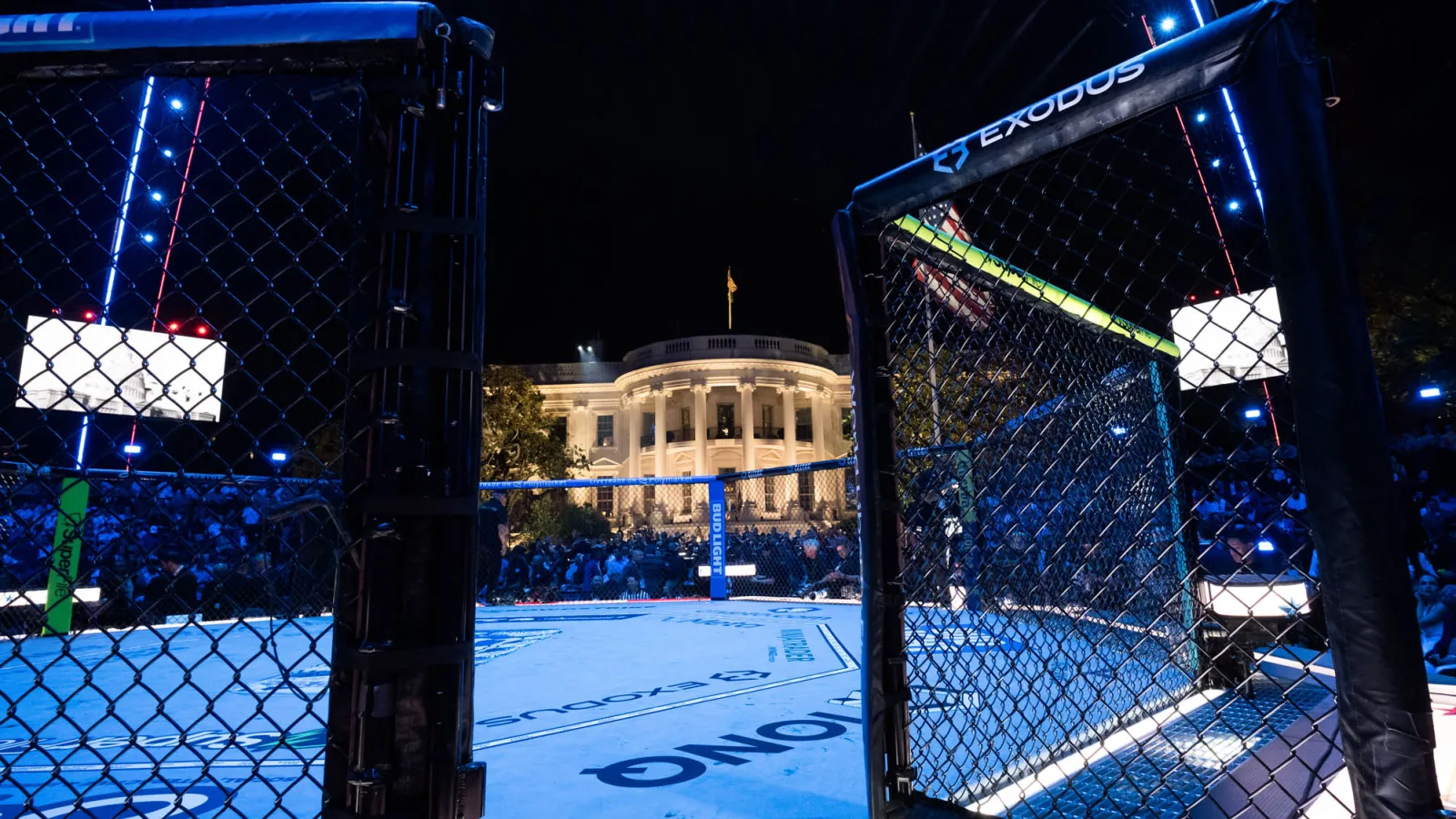
On Sunday night, Trump’s 80th birthday, the UFC hosted a blowout event on the White House’s South Lawn, in an arena custom built at cost by the UFC and its president, Dana White, who is one of Trump’s closest personal friends and most important political allies. White and everyone around him delivered for the President: eight bloody fights, all of which ended in a knockout, two military flyovers, a fireworks show, and an entire weekend of supplementary events devoted, ostensibly, to celebrating the country’s 250th anniversary. Trump sat near Mark Zuckerberg and Larry Ellison, whose billion-dollar companies helped put on the event. Kid Rock was there as was recently-victorious New York Knicks owner James Dolan. Across the street, in the Ellipse — a huge grassy field directly across from the South Lawn — tens of thousands of fans packed in front of jumbotrons to watch the fights, walled off from the actual arena by walls and barricades and razor wire and hundreds of armed guards, but close enough to feel like they were part of something big, something beautiful, something shared and special and thrilling.
THE CELEBRATION OF DONALD TRUMP’S AMERICA started in earnest a few days before, on Friday evening, at the Lincoln Memorial. Below Honest Abe, the PA system blasted “99 Problems” by Jay-Z and “Click Click Boom,” by the band Saliva. The sky was a lurid, incredible shade of peach, the sun setting in the wake of a series of thunderstorms. Images of the fighters splashed out over the white marble of the memorial, projected at huge scale on “Monuments built by a nation to honor greatness,” as White put it in a pre-recorded video that played before the fighters made their way down the steps.
For weeks, critics had been howling about moments like this: perversions of America’s most hallowed ground, crony capitalism enshrined by the President himself. Polling on CNN showed that 16 percent of Americans and only 36 percent of Republicans, even, thought the UFC fight at the White House was “appropriate.” The comments section of every article on the topic are filled with screeds from people decrying the desecration of America’s landmarks, its history, its culture and decorum.
The press conference at the Lincoln Memorial made these criticisms pretty easy to see. Josh Hokit, an American wrestler turned NFL player turned heavyweight UFC fighter, hijacked the show at every opportunity, doing a strange bit where he mumbled responses to basically everything any other fighter said, pretending to be a stuttering, shy version of himself struggling to hold back his darker side, which he called “the Incredible Hok,” that nevertheless slowly slipped out as his responses grew more and more vulgar. Going into the various pathologies of Josh Hokit would take thousands more words — at weigh-ins the next day, he pretended to be drunk and threw up on himself — but his performance at the presser was so absurd even by UFC standards that it left most of the audience and the other fighters onstage looking confused and uncomfortable.
“Happy Birthday America!” White yelled when he took the mic, before announcing that deserving fighters would receive additional bonuses of $250,000 to $400,000 from World Liberty Financial, a cryptocurrency company owned by the Trump family.
The following day, I walked down to the White House to check out the UFC’s “Fan Fest” event, which had been set up on the Ellipse. The UFC’s custom-built arena, a massive metal structure called the “Claw,” was visible over the tops of the trees and fences, lit up in red and blue. UFC fans had completely swarmed downtown D.C., and by Saturday afternoon, thousands of them were sweltering in gigantic lines for a myriad of fan experiences put on by the UFC’s many prominent sponsors. Dodge Ram Trucks were jacked up on huge lifts in one section next to a Ray Ban Meta AI locker room. (“This thing’s badass,” a gangly 20-ish kid said to his buddies, looking admiringly at the Dodge racing truck on display.) Another stage hosted the Monster Energy Drink Girls, who were taking pictures with shirtless fans wearing replica UFC gloves. There were at least three full-size octagons to take pictures in, and half a dozen booths with retired or former fighters doing meet-and-greets. You could take pictures with the Budweiser Clydesdales, two placid-looking horses rotated in and out of the photo line and a small metal stall set up under a tent. Motocross legend Travis Pastrana popped up on the main stage wearing a shirt for Black Rifle Coffee Company, an aggressively right-wing coffee brand that sponsors the UFC.
The jumbotrons, meanwhile, played a looping selection of ads for the late Christian Nationalist Charlie Kirk’s Turning Point USA organization and a company called “VetClaims.AI.” There were Secret Service recruiters and a detachment of Marines standing around near a parked Amphibious Combat Vehicle. I was still trying to shake off the heady Lincoln Memorial event, and the all-senses assault of branding and advertising wasn’t helping. But the fans in the Ellipse weren’t as cynical. As I ducked under a large tent near the Clydesdales to get some shade, I met three guys in their late thirties who had had the same idea. They were old friends from a martial arts gym who were spread around the country now, but had reunited in D.C. for the fights.
“A lot of people talk about how everything’s so political, everything’s so divided,” Johnny, a Brazilian jiu jitsu instructor from San Diego, tells me. “You have people from all races, colors, creeds, all here celebrating this.”
Read more Donald Trump’s Name Has Been Removed From the Kennedy Center, Court Docs Say
“That’s what makes the UFC great,” Johnny’s buddy Tony, a D.C. local, chimed in. “That’s what makes America great.”
Johnny’s sentiment echoed something I’ve been trying to explain to the effete liberals of New York media for years: Mixed Martial Arts is a humbling, dignified sport, one that contains some of the most compelling feats of athleticism and sportsmanship I’ve ever seen. Johnny and his friends saw past the relentless advertising and constant, clumsy jingoism of the UFC and found something good in the experience: fans from all over the country and the world here to celebrate a sport and a country they loved. This was the American dream, right here in the nations’ capitol, free for anyone to come and get a taste of. It was a refreshing way to look at the world, one that made me optimistic that some day the sport of MMA won’t be inextricably linked to all things tacky and crude. As I ruminated on this, making my way to the exit, I passed a fan in a neon green baseball hat that said “RETARD” on the front. Win some, lose some.
ON SUNDAY NIGHT, THOUGH, THERE WAS ONLY one future on display: the total dominance of the political and financial project led by Donald Trump. On the South Lawn, the massive steel claw loomed over a 4,000-seat arena with the octagon at its center. Around the cage was a remarkable gathering of the country’s political and corporate elite — not just Zuckerberg and Ellison, but also the heart of Trump’s political apparatus, including Vice President J.D. Vance, FBI Director Kash Patel, advisor Stephen Miller, Texas Senator Ted Cruz, and Health and Human Services Secretary Robert F. Kennedy, Jr.
Surrounding the elites, on the upper tier of the carpet-covered metal bleachers, closest to the outside world, was a ring of young, fit enlisted members of the military — specifically chosen to be telegenic, according to reports before the fight. A squadron of fighter jets ripped overhead, spewing vapor trails that looked black in the darkening sky. Later in the night, a single B-1B Lancer, America’s most advanced long-range bomber, blasted past in the opposite direction, its four engines glowing blue, so low that you could feel their roar in your chest. The image was clear: This is America, this lawn, filled with the rich and powerful, insulated by the collective military might of an empire. A few hours earlier, Trump had signed a ceasefire agreement with Iran, but the UFC’s programming hadn’t caught up: In between Bud Light ads, the jumbotrons played a blitz of what appeared to be AI-powered military propaganda. I watched AI Paul Revere shout about redcoats and AI American GI’s storm the beaches of Normandy, sometimes narrated by White’s voice, making parallels between the warriors who forged this nation and the ones in the cage.
Which brings us to the fights. They went as promised: bloody, violent, often short. Savvy MMA analysts noted weeks before that the White House fights were largely mismatches where one fighter was heavily favored. Seven fights came and went, all knockouts, most won by the favored fighter. Josh Hokit, the mumbling troll from the press conference, became a fast, deadly competitor in the cage, swarming and dispatching Trump’s favorite fighter, an aging veteran heavyweight named Derrick Lewis. But Hokit immediately proved himself a willing replacement for Lewis, kowtowing to Trump and seizing the microphone for the night’s most singularly disgusting moment. “Shout out to Trump for having the balls to put something like this on,” Hokit said, before praising his “Lord and Savior Jesus Christ.” He then continued. “And lastly: Michelle Obama is a MAN! Am I right, America?” There was a smattering of cheers and groans.
“Ladies and Gentlemen, Josh Hokit!” Joe Rogan, the ringside commentator, exclaimed as Hokit danced away, a grin fixed on his face.
And yet violence often defies expectations. In the main event of the night, Justin Gaethje, a 37-year-old veteran lightweight brawler from Arizona, faced down one of the sport’s most lethal fighters, the 29-year-old Spanish-Georgian lightweight champion Ilia “El Matador” Topuria. Going into the fight, Topuria was 17-0, many of his wins coming from dazzling, devastating knockouts. But he didn’t get his bull. In the first two rounds, Gaethje weathered a barrage of brutal shots, giving almost as good as he got but nearly folding to repeated, surgical strikes to his liver and body. But Gaethje never stayed down, and little by little, Topuria crumbled, his face slowly turning to an unrecognizable slab of meat, broken and bloodied and so swollen that the ringside doctor tried to call off the fight after the third round. The crowd howled, Topuria protested, and the referee stepped in to sign off on another round. In the fourth, Gaethje hammered him. Afterwards, Topuria sat on his stool with his head hanging down dripping blood onto his hands. His brother, standing beside him, urged him to finish the fight. Topuria did not move, and another coach threw in the towel. Gaethje had won.
This is the beauty of MMA. For 20 minutes, the world shrank down to two men in a cage. I wasn’t thinking about AI, or crypto, or the optics of young servicemen and women used as stage props for a consortium of the richest people in the world. All that mattered was the story being told — of a man from Arizona who had spent his life fighting and never achieved his championship dreams, of a champion finally meeting a contender he couldn’t knock down. There it was, in the cage: the American Dream.
This was what the thousands of people watching across the street had come to see, even if witnessing it in the flesh was reserved for the kind of people who have never had to fight a day in their lives. You watch a guy like Gaethje, his face lumped and leathery from past fights, take the best a pristine champion can offer and give it back to him in full, and you start to feel like maybe your dreams are possible, too. That the things you want — a new house, a new job, college tuition for your kids, or even just a trading card signed by your favorite athlete — are attainable. That’s what Dana White and the UFC sell. They use the beautiful catharsis and humility of organized violence to show you a world where dreams do come true. To get there, all you have to do is sign up for Paramount Plus. All you have to do is invest in crypto, drive a Dodge truck, drink a Bud Light, vote for Donald Trump. The people who believe this, who drive for hours to watch fights on a giant TV in a sweltering public park, aren’t stupid. As a whole, they’re not all tacky or crude. They’re just American, living in a country that promises so much and delivers so little.
The people making the promises, though — those are the ones who you have to watch. The people who get what they want are doing it at someone else’s expense. After the fights, White announced that the UFC’s merchandise sales that weekend had doubled their past record.
“There was no political agenda for this event,” White told the media. “I believe that no matter where you sit politically, tonight was a proud night.”
Read more Trump Is Throwing Himself a UFC-Themed Birthday Party. Actors and Activists Are Fighting Back
