Trump Wants to Drill A Sacred Native American Site. Can It Be Saved?
Chaco Canyon, located in Northeast New Mexico, is infamous for being arid, but on the day I arrive, the road is nearly washed out from a July monsoon. Thunder echoes off the ancient stone ruins that make the place a UNESCO World Heritage site and national park, and the hypnotic smell of wet sage perfumes the air. I’ve come to meet Mario Atencio, a Diné (formerly Navajo) organizer who has been fighting to protect the Greater Chaco area from oil and mineral extraction, and his grandfather, Daniel Tso, from whom Atencio inherited that fight, now in the national spotlight due to the “drill baby, drill” Trump Administration’s renewed interest in the oil fields that surround Chaco.
Read more The Covid Origin Saga Is More Complicated Than Either Side Wants to Admit
We convene at the visitor’s center at 7:30 a.m., the rocky landscape surprisingly tender in the damp dawn light. Atencio, rocking an olive bucket hat, gets there first; he’s been on the road since 4 a.m. to make our rendezvous. Tso, white hair tucked into a traditional bun at the nape of his neck, pulls up next in a black beast of a truck, eyebrows wagging. “So you’re the pebble in the wash!” he crows when I introduce myself as a reporter from Rolling Stone.
For many Native peoples of the Southwest, including New Mexico’s 19 Pueblo tribes and the Diné, Chaco Canyon is holy ground. “We’re literally in the place where gods walked,” offers Atencio, referencing oral traditions not intended for public consumption. “Our ceremonies were born here.”
Now, the Trump Administration wants to make the sacred profane. Earlier this month, the Bureau of Land Management announced it wants to “revoke the withdrawal of up to approximately 336,425 acres of public lands located within a radius of approximately 10 miles surrounding Chaco Culture National Historical Park.” The “withdrawal” was created in 2023 by then-Secretary of the Interior Deb Haaland to block new drilling around Chaco Culture National Historical Park. According to the current administration, this buffer zone is excessively big, so they want to shrink it, just as they reduced protected acreage around Bears Ears and Grand Staircase-Escalante by roughly 90 percent earlier this summer. In a blow to the democratic process, the BLM has also shrunk the required public-comment period to just 14 days, meaning that for grandfather and grandson, time is of the essence before the comment period closes July 29.
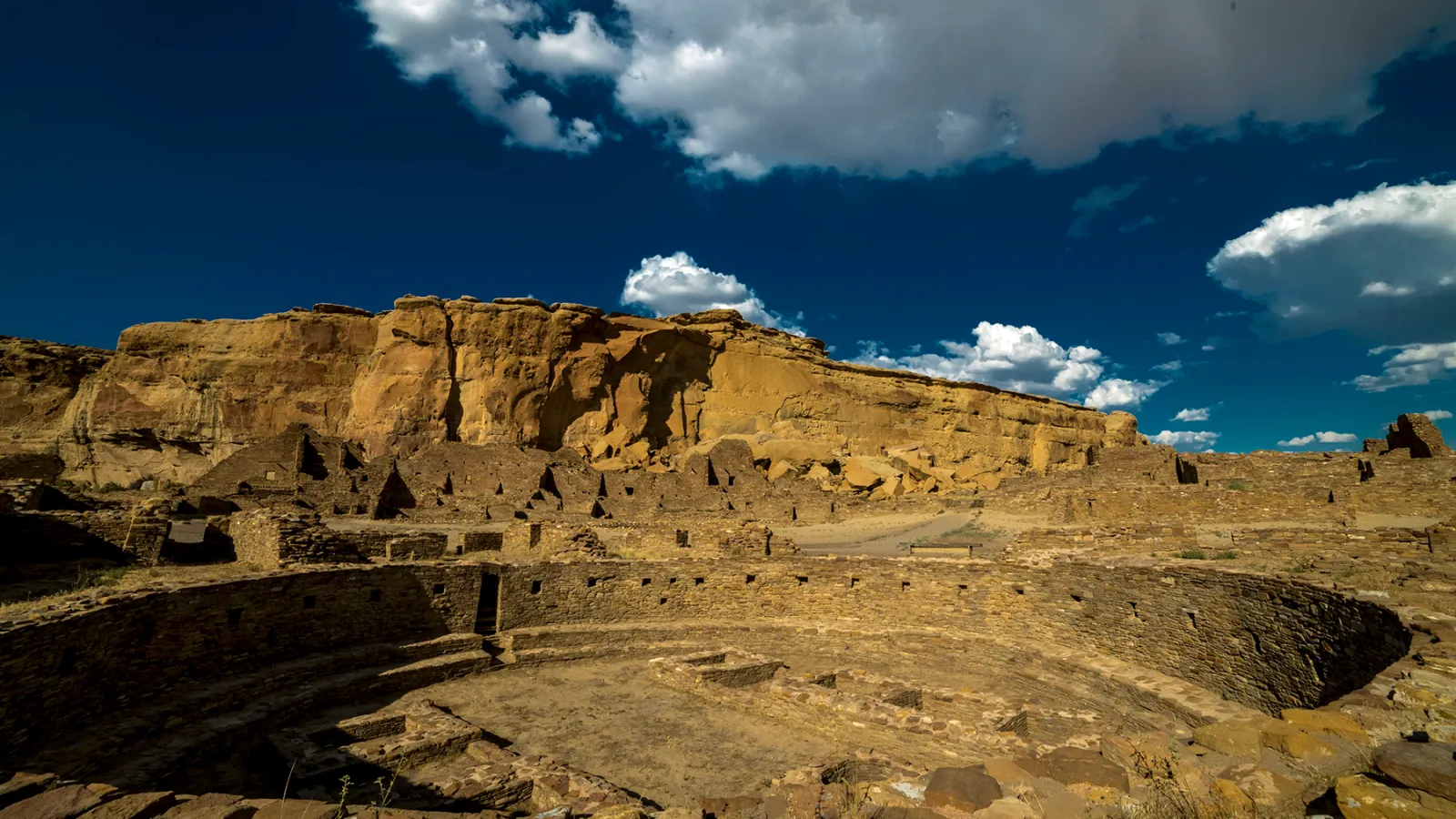
We sit at a picnic table, and one of the greatest architectural wonders in the U.S. stretches out behind us. Between 850 and 1250 CE, at a time when medieval Europe was gearing up for the Crusades and China was developing paper money, Puebloan people — who later intermarried with the Diné, thus becoming Tso and Atencio’s ancestors — were building six-story stone structures that, until the 1800s, were the tallest buildings in North America. To this day, Chaco Canyon remains largely a mystery to archeologists who recognize it as an astronomically-aligned ceremonial center, and a hub in a vast migratory network that stretched to California and Mexico, as evidenced by the seashells and macaw feathers that have been unearthed alongside the intricate mortar and masonry.
To be clear: No one is proposing detonating any stone homes, or drilling through any petroglyphs, as some social media posts would seem to insinuate. However, critics of the BLM’s proposed reduction argue that thousands of unexplored archeological sites lie within the 2023 buffer zone, placing them at risk, and that to confine Chaco Canyon to just a few miles imposes colonial constructs over a cosmological map that is vast by design. “Chaco is not just here in the buffer,” explains Atencio. “It extends out and into sacred places outside. So the greater Chaco landscape goes from here to Bears Ears.” Bears Ears connects to Mesa Verde and beyond.
But Chaco’s secrets are not the only thing at stake. Its flesh and blood descendants are, too. “This is not just an empty wasteland,” says Atencio. People live here.”
IT’S NOT EASY TO SEE AT FIRST. The American West is remote, and Chaco is no different. All I have observed for miles is sage, and the occasional gas station, I’m pretty sure. Then Tso unrolls a map, and a patchwork of squares, called allotments, come into view. Extending West from the nearby Navajo Nation — the reservation where nearly 200,000 Diné people live — the allotments pepper the 10-mile buffer zone in question. Several belong to Tso, inheritances from his grandparents who once lived inside Chaco Canyon raising sheep and corn, before the federal government kicked them out to create the park in 1907.
The allotments were their concession, a byproduct of the 1887 Dawes Act, which paved the way for the federal government to break up communally owned Native American reservation lands into private parcels, with the goal of dividing tribes as a social unit. According to the National Park Service, tribes lost about 90 million acres, or two-thirds of what they controlled in 1887, to the allotment system.
Later, many of these Native allotment holders discovered they were oil-rich, and were murdered for it, as depicted in Killers of the Flower Moon, the 2017 book by David Grann, and 2023 adaptation by Martin Scorsese, about the Osage murders in Oklahoma in the 1920s.
Today, some Diné allotment holders are the most vocal proponents for oil-drilling around Chaco. As Delora Hesuse before the House Committee on Natural Resources in 2019, back when New Mexico lawmakers were attempting to create the buffer zone via legislation,
“Many people don’t understand our Native American heritage and the fact that many individual Navajo Nation members such as I own private lands and the minerals underneath them. This is a steadfast personal property right that sustains our livelihoods and way of life. H.R. 2181 would put many of our mineral rights off limits and stop a much-needed source of income to feed, shelter, clothe and protect our families. I’m not exaggerating the importance of this income. In 2015, the Federal Indian Minerals Office distributed $96 million to 20,835 allottees. That’s a significant source of income in an area that continues to struggle with unemployment.”
Even though the buffer zone allows allotment holders to continue leasing their land to oil and gas companies, many still oppose it because it makes extraction less attractive to companies, who would prefer to cluster multiple wells close together.
Read more Two Men Found Guilty in Double Murder of Special Effects Guru and His Partner on Caribbean Island
So far, Navajo Nation is taking Hesuse’s side. In May, President Buu Nygren (who has since lost reelection) met with the BLM, and reiterated the tribal government stance: no buffer zone. “Everything was good before this started,” he reportedly said.
Atencio disagrees; everything has not been good. We caravan a few miles to an oil well, and watch as it belches shimmering flares. Some 40,000 of these wells have been drilled in the San Juan Basin, a fossil fuel rich region that backs onto Chaco Canyon. Natural gas was discovered here in 1921, and despite often being overshadowed by the Permian Basin in the Southwestern part of New Mexico, San Juan is sometimes touted as the nation’s largest gas field.
It’s also been sucked silly for a very long time. According to the BLM’s own assessment, only 14 new potential wells exist within the buffer zone. Top dog producers like ConocoPhillips, BP, and ExxonMobil have all left, leaving San Juan to smaller players like Hilcorp Energy and Enduring Resources. Atencio has been working with Native environmental scientists such as Dr. Tommy Rock, a sustainability professor at Northern Arizona University, to try to understand their cumulative impact.
“The issue is not only about the national park,” says Rock when I reach him by phone, “but also the water quality and how it’s gonna damage the environment, as well.”
After a research fellowship at Princeton University, Rock led a pilot study monitoring air quality in Counselor, an unincorporated community near Chaco that is a chapter of Navajo Nation. The results were, quite literally, dizzying: He detected elevated levels of benzine, a cancer-causing by-product of natural gas production. Benzine is just one chemical in a toxic soup of many that Rock suspects are causing many of the respiratory problems that residents experience.
Both Rock and Atencio worry about the children of Counselor. Lybrook Elementary School is less than a mile from several oil and gas wells, and students there report headaches, vomiting, and the smell of foul odors. “It’s disturbing,” says Rock, especially as Trump rolls back the Clean Air Act, Safe Water Act, and others. “Who’s going to help the communities that are suffering?”
THE DINE ARE NOT THE ONLY Native Americans affected by the BLM’s Chaco Canyon decision. While they happen to live the closest, and have the most political power due to being the largest federally recognized tribe, Chaco’s most direct descendants are the Pueblo peoples. Pueblo peoples include the Hopi and the Zuni, and also many smaller groups like Acoma Pueblo and Taos Pueblo.
Dr. Doreen Bird, a public health consultant and member of Santo Domingo Pueblo, population 2,000, describes herself as a “Pueblo woman from the dirt.” When I catch up with her, she is preparing clay to make pottery as her mother taught her, in a style that bears striking similarity to shards found at Chaco Canyon.
The first time she visited Chaco, she says, “I made my offering and announced my presence and really just was in awe, feeling like it was my home. Even though there’s rangers there, I felt like it was my home.”
In 2025, genetic testing established a link between Picuris Pueblo, north of Santo Domingo, and ancient Chacoans. “ We don’t need to prove that we’re connected, but people want proof. We have it in our songs and in our stories and our DNA,” she says.
For Bird, there is no separation between the cultural concerns surrounding Chaco and the ecological. “ As humans we’re part of nature, right?” she says. “I like how some of the youth frame it: desecrating our Earth is just like desecrating our bodies.”
For Bird, it is mind boggling that that government, even some Native people, don’t seem to grasp the reality of our interconnection.“The heartbreak is unexplainable. How can some people not care about clean water? And care more about money or nuclear weapons than the safety of humanity and animals? I just can’t believe that we’re having to live through this, but we are.”
Read more ‘Unhinged Obsession’: Fauci Hearing Goes Off the Rails After He Stonewalls Senators
